
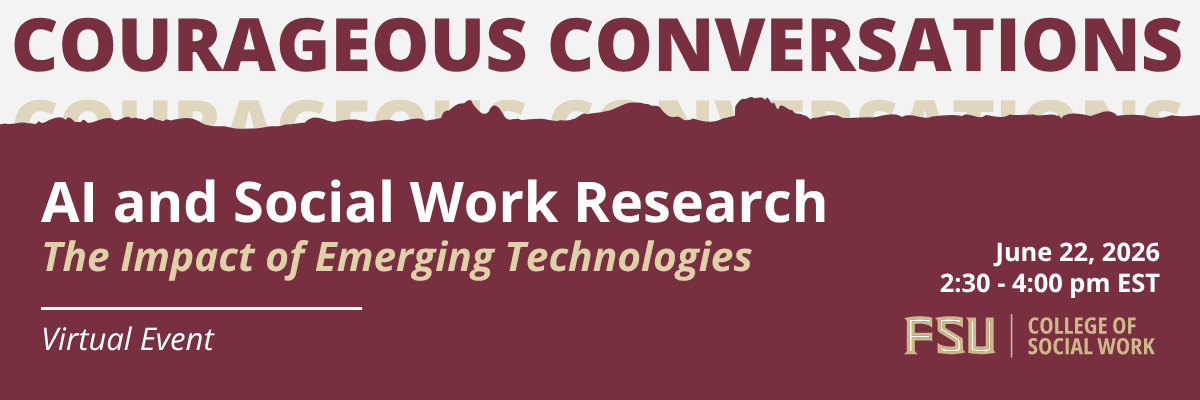
AI and Social Work Research: The Impact of Emerging Technologies
This message has been approved by Dr. David Springer, Dean and Guy & Delores Spearman Professor of Social Work, for distribution to students, faculty and staff.
Join FSU College of Social Work faculty and alumni on June 22 at 2:30 p.m. ET for a conversation on the impact of emerging technologies and artificial intelligence (AI) on social work research and practice. Panelists will highlight current FSU research using AI innovations and explore the broader questions these technologies raise for the field. Selected questions submitted in advance will also be addressed.
Submit Questions: Please share your question(s) related to social work research and practice related to artificial intelligence (AI) and other emerging technologies. (*Please note that every question may not be addressed during the live event.)
Click Here to Submit Questions
- Click Here to Register (*Registration is required.)
Panelists:
Dr. Shannon Bennett is a licensed psychologist and licensed school psychologist. She is the director of the FSU Multidisciplinary Evaluation and Consulting Center, or Multidisciplinary Center, housed at the College of Social Work. The center provides a range of services to preschool and school-aged children, including diagnostic evaluations, individual and group therapy, and consultation. In addition, the MDC provides pre-service and in-service training for parents, teachers, other school district personnel, and related providers and professionals. The MDC offers APA-accredited psychology internships, as well as other training placements, for doctoral and master's-level students in psychology, social work, and marriage and family therapy.
Dr. Kaela Byers is an associate professor at the FSU College of Social Work, with expertise in child welfare. Her research and scholarship focus on community, structural, and systems-level issues that impact children, families, and their communities. She applies a community-engaged approach to research, using advanced mixed-methods, implementation science, and a translational prevention framework. More specifically, her research addresses social determinants of health, protective factors, and child welfare system change.
Dr. Michael Killian is an associate professor at the Florida State University (FSU) College of Social Work and has a courtesy appointment as a professor in the FSU College of Medicine. He is also a research faculty member at the Children’s Medical Center of Dallas and their Solid Organ Transplant Program. He serves as a research scientist for the Center for the Study and Promotion of Communities, Families and Children at the FSU College of Social Work. His primary research focus surrounds pediatric organ transplant recipients and their families, adherence to medication regimens, and post-transplant health-related quality of life and health outcomes.
Dr. Lisa Magruder is the director of the Florida Institute for Child Welfare, housed at the College of Social Work. She is a two-time FSU graduate, earning a bachelor's degree in psychology and sociology, and her MSW in 2011. She earned her doctoral degree in social work at the University of Denver Graduate School of Social Work. After returning home to Florida, Lisa served as the staff liaison to the Tallahassee/Leon County Commission on the Status of Women and Girls for two years before joining the FSU College of Social Work as the project manager of the Florida Study of Professionals for Safe Families, the cornerstone of what is now the GROW Center at the Florida Institute for Child Welfare. Following receipt of her doctorate in 2017, Lisa continued her work at the institute as a postdoctoral scholar, then as associate director of research, before stepping into the role of institute director. She has led or supported several studies at the institute and published extensively in child welfare and youth and family well-being.
Dr. Yaacov Petscher (moderator) is a professor of social work at Florida State University, an associate director of the Florida Center for Reading Research, and the director of the Quantitative Methodology and Innovation Division at FCRR. His work focuses on measurement, causal modeling, the study of individual differences in reading using complex methodologies, and the development of screening assessments and computer-adaptive tests. He is the recipient of the 2011 Rebecca Sandak Young Investigator Award from the Society for the Scientific Study of Reading, the 2012 Article of the Year Award from Assessment for Effective Intervention, the 2014 Dina Feitelson Research Award from the International Literacy Association, the 2014 Educational Researcher of the Year Award from the Florida Educational Research Association, and a 2017 FSU Innovator Award from Florida State University. He has co-authored nearly 200 peer-reviewed articles, book chapters, and technical reports and co-edited The Fluency Construct and Applied Quantitative Analysis in Education and the Social Sciences books.
Dr. Tanya Renn is an associate professor at the College of Social Work and is the director of the FSU Justice and Health Research Innovation Institute at Florida State University. Further, Dr. Renn serves as a research scientist collaborating with colleagues at the Center for the Study and Promotion of Communities, Families, and Children to conduct research in school and foster settings throughout Leon and Gadsden counties. Dr. Renn’s primary research focuses on understanding the relational pathways that exist between stress, trauma, substance use, and well-being among vulnerable populations, specifically those involved in the criminal justice system. Dr. Renn focuses on developing and adapting evidence-informed interventions that improve the health and well-being of vulnerable groups in community-based settings (i.e., prisons and jails, substance use disorder treatment settings, and schools).